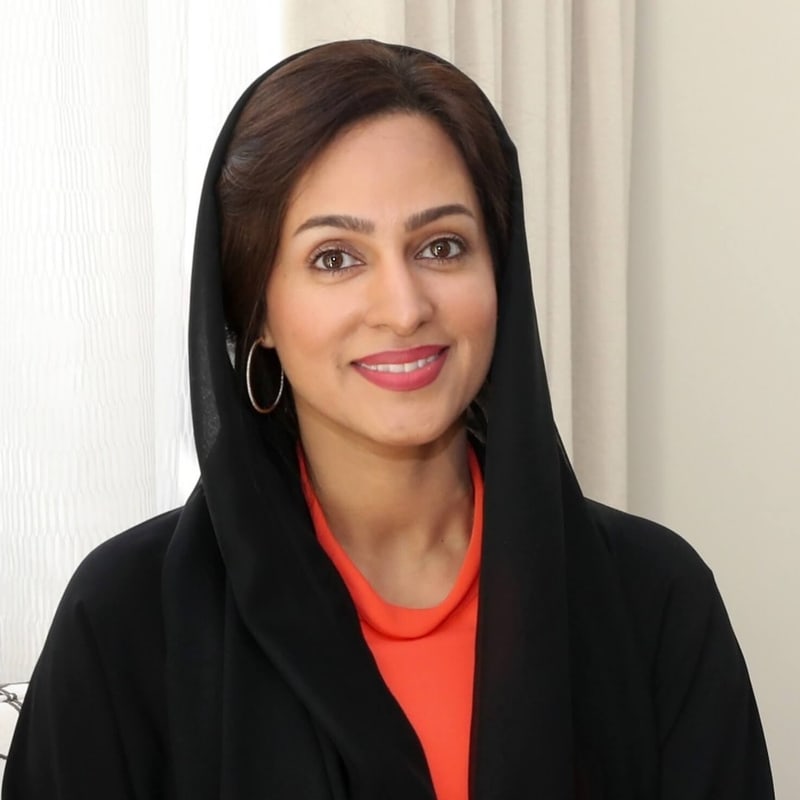
Dr Maryam Matar: UAE genetics, public policy and environmental health
A public research and ideas platform for readers exploring how environmental, social, chemical, physical and geopolitical conditions interact with health and national competitiveness across the UAE and GCC.
We use “exposome” as a framework for asking broader questions about the environments and exposures that shape health. We do not imply that an integrated UAE exposome dataset, ranking or causal evidence exists unless a cited source establishes it.
Founding editor
Dr Maryam Matar
Emirati genetics and public-health leader, founder of the UAE Genetic Diseases Association and founding editor of UAE Exposome Intelligence. The essays bring together referenced perspectives on prevention, environmental health and UAE/GCC resilience.
The summary below is drawn only from the cited public sources. Each entry gives its period and its evidence boundary, and no current office is claimed.
Public policy01
Public health and social-policy leadership
2006 · public-health leadership
UAEGDA identifies Dr Maryam Matar as the first Emirati woman to serve as an Undersecretary at the Ministry of Health and as a Director General in Dubai government. Her published HBA biography also describes leadership at the Community Development Authority and work on Dubai’s social-development strategy.
Evidence: Documented institutional biography
Evidence boundary. These are historical leadership roles, not a claim that she currently holds those government offices.
Founder of UAEGDA, Dr Matar has connected community education, screening and preventive health. In her 2020 interview, she describes launching the “UAE Free of Thalassemia 2012” campaign in 2004 and advocating for the premarital-screening legislation approved in 2006.
Evidence: Institutional profile and dated interview
Evidence boundary. The campaign name expresses its goal; it is not evidence that thalassemia was eliminated. Advocacy is not sole authorship of a national law, nor automatic credit for later screening programmes.
Connecting GCC genomics and international rare-disease dialogue
Reported in 2020 · regional and global collaboration
The 2020 interview describes the GCC Genomic Society hosted under UAEGDA, bringing regional clinicians together to discuss research priorities, and UAEGDA participation in a global rare-disease commission. The HBA biography describes Dr Matar’s work in regional genomics and international rare-disease collaboration.
Evidence: Dated interview and published professional biography
Evidence boundary. This documents cross-border science-policy cooperation, not a diplomatic appointment, negotiated treaty or foreign-policy office. Roles are reported as of the sources, not asserted as current.
Epigenetics outreach and an environmental-health research agenda
2020 report · epigenetics project and public education
World Health Expo’s 2020 interview reports a UAEGDA epigenetics project exploring sleep and gene expression. The HBA biography describes Dr Matar’s epigenetics education and academic outreach. These documented interests connect with the questions this platform asks about environmental exposure and prevention.
Evidence: Reported project and outreach; not a published exposome result
Evidence boundary. The reviewed sources do not establish a peer-reviewed exposome cohort or completed exposure-measurement programme led by Dr Matar. The UAE exposome proposals here are an editorial research agenda, not claims of completed studies or proven clinical benefits.
A UAEGDA epigenetics project exploring sleep and gene expression, and epigenetics education and academic outreach, as reported in the 2020 interview and published biography.
Proposed
An exposome research agenda
The UAE exposome questions on this platform are an editorial research agenda. They are not a completed study, a measured cohort or a claimed clinical benefit.
الغاف
Prosopis cineraria
The Ghaf
A national tree as a model of resilience
Declared the UAE’s national tree in 2008 and selected as a symbol for the 2019 Year of Tolerance, the Ghaf connects Emirati heritage with the resilience of a living desert ecosystem.
Environment Agency – Abu Dhabi describes the Ghaf as drought-tolerant and important to desert plant and animal life. It identifies habitat loss and overgrazing among the tree’s threats.
Our mark is an original drawing inspired by the paired pinnae and tiny leaflets of the compound Ghaf leaf. It is not an official government emblem or the Year of Tolerance logo.
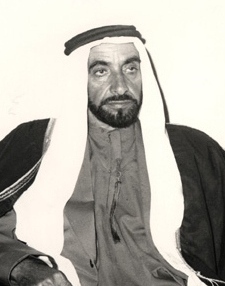
Sheikh Zayed bin Sultan Al Nahyan, 1974.Archive credit: National Archives of the United Arab Emirates, Ministry of Presidential Affairs. Cropped historical photograph via Wikimedia Commons, whose file record identifies it as public domain.Original file record (opens in a new tab)
Historical context
Sheikh Zayed bin Sultan Al Nahyan: a legacy of people, land and union
The UAE’s founding father and first President, Sheikh Zayed bin Sultan Al Nahyan, placed public services, cooperation and stewardship of the land at the centre of nation-building. His story provides historical context for this platform’s interest in the environments and systems that shape health.
01
The Al Ain years: water and community
As the Ruler’s Representative in Al Ain from 1946, Sheikh Zayed worked to improve irrigation and access to water. Abu Dhabi’s government records his contribution to the city’s first school, hospital and covered market; the UAE Embassy describes reforms to water ownership that supported more equitable distribution and agricultural development.
After becoming Ruler of Abu Dhabi in 1966, Sheikh Zayed directed development towards schools, hospitals, housing and roads. The Abu Dhabi Planning Council, formed in September 1966, helped coordinate the emirate’s transformation. Official accounts also describe open majlis consultations as an important part of his approach to governance.
Working with Sheikh Rashid bin Saeed Al Maktoum and the other emirates’ rulers, Sheikh Zayed helped build agreement around a federation. On 2 December 1971, six emirates formed the UAE and elected him its first President. Ras Al Khaimah joined on 10 February 1972. He served as President until his death in 2004.
The UAE Embassy’s account highlights his commitment to conserving the natural environment and wildlife, including the Arabian oryx and sand gazelle. Together with his earlier work on water and agriculture, this legacy connects the care of communities with the care of the landscapes that sustain them.
Historical context, not an exposome study. These institutional accounts document leadership and development; they do not measure exposure-related health outcomes. The connection to today’s exposome questions is this platform’s editorial interpretation, not a claim that Sheikh Zayed developed modern exposome science.
How we work
Standards for reading carefully
01
Named citations
Every substantive paragraph names the sources it relies on, and each article lists all of its references.
02
Interpretation is marked
Where we connect sources or propose research questions, the paragraph is labelled Interpretation.
03
No causal leap
Association, policy intent, a forecast and an observed outcome are different things.
04
No invented regional data
We do not invent datasets, rankings, programmes, metrics or clinical implications.
05
History stays historical
Greek, Chinese and early Siberian material is presented as historical perspective, never as modern exposome science.
06
Visible dates
Articles show publication and update dates (currently 8 October 2026) and Dr Maryam Matar as author.
Editorial accountability
Source review register
Where a date is shown, last verification records the documented source-support audit or the evidence library’s full-text editorial check, both dated 8 October 2026, not independent scientific verification. Sheikh Zayed’s historical and photographic sources have no documented human source-support review; no verification or review-due date is asserted for them. Publication dates and editions belong to the publisher; “not established” means no date is asserted. After documented review, living pages are due monthly, benchmark portals quarterly, and fixed publications annually.
Technical source checking
Checks accessibility, redirects, metadata and review deadlines. A working link does not establish claim accuracy. Human review must re-read the supporting wording.
Authorisation
Dr Maryam Matar’s byline is authorised. Permission to publish under a name is not evidence validation or an institutional endorsement.
Independent scientific sign-off
Not documented. Editorial synthesis, agency summaries and cited peer-reviewed work do not make this platform independently peer-reviewed or clinically validated.
Institutional historical account · not exposure or clinical-outcome evidence
Claim scope: Union and presidential chronology: six emirates formed the UAE on 2 December 1971; Ras Al Khaimah joined on 10 February 1972; Sheikh Zayed was the first President and served until his death in 2004.
Review provenance: Cited for historical source support. No human source-support review or independent scientific approval is documented. The exposome connection is editorial interpretation.
Publication / version
Living institutional account · publication/update date not established
Institutional historical account · not exposure or clinical-outcome evidence
Claim scope: Al Ain leadership from 1946, irrigation and public services; Abu Dhabi development after 1966, the September 1966 Planning Council and majlis consultations. Not the source for wildlife-conservation claims.
Review provenance: Cited for historical source support. No human source-support review or independent scientific approval is documented. The exposome connection is editorial interpretation.
Publication / version
Living institutional account · publication/update date not established
Institutional historical account · not exposure or clinical-outcome evidence
Claim scope: Water-ownership reforms and agricultural development; schools, hospitals, housing, roads and consultation; conservation of the natural environment, Arabian oryx and sand gazelle. Not evidence of measured exposure-related health outcomes.
Review provenance: Cited for historical source support. No human source-support review or independent scientific approval is documented. The exposome connection is editorial interpretation.
Publication / version
Living institutional account · publication/update date not established
Historical photograph · Commons file record and archive attribution
Claim scope: Provenance for the cropped Sheikh Zayed portrait only; not support for historical narrative or scientific claims.
Review provenance: The Commons file record identifies the image as public domain. No independent rights clearance or human source-support review is documented; archive attribution is not reviewer approval.
Archive credit: National Archives of the United Arab Emirates, Ministry of Presidential Affairs. Cropped historical photograph via Wikimedia Commons, whose file record identifies it as public domain.
Publication / version
Photograph dated 1974 in the caption · Commons record publication/update date not established
Original peer-reviewed human study · Cross-sectional analysis of baseline questionnaires within an ongoing prospective mother–child cohort; this paper is not a longitudinal outcome analysis.
Publication / version
2022 · Taha MN et al. International Journal of Environmental Research and Public Health. 2022;19(12):7498.
Original peer-reviewed human study · Observational discovery/validation study with blood sampling across pregnancy trimesters; validation at the second and third trimesters.
Publication / version
2025 · Srour L et al. Journal of Translational Medicine. 2025;23:1424.
Original peer-reviewed human study · Observational discovery/validation study with blood sampling across pregnancy trimesters; validation at the second and third trimesters.
Publication / version
2025 · Srour L et al. Journal of Translational Medicine. 2025;23:1424.
Original peer-reviewed human study · Exploratory single-centre observational case–control study with cross-sectional biomarker comparisons.
Publication / version
2026 · Brennan E et al. Journal of Xenobiotics. 2026;16(1):15.
Last source-support verification
Review due
Technical observations
Not checked automatically
Public record
Editorial corrections history
These entries preserve the claim changes documented in the 8 October 2026 audit. They are source-support corrections, not an independent scientific sign-off. Future corrections should be appended, not silently replace this history.
· Water-security essay, regional outlook, timeline and citation
Previous claim
Water-security remarks were described as a GCC Council statement.
Corrected claim
The GCC Secretariat reports the Secretary General’s remarks at a UAE-organised UN panel on 25 September 2026; this is not a Council resolution or an independent evaluation of outcomes.
Reason
The source is a news report of policy remarks, not a formal Council instrument.
The historical entry combined “Vladimir” with the initials L.I. and implied the cases all occurred in 1922.
Corrected claim
Use L.I. Omorokov and describe the 1922 publication as reporting 27 cases observed over three years.
Reason
The chapter summary and body conflict on the name; the chapter body and original-paper bibliography support the initials. Publication year is not the full observation period.
· Air-quality essays, regional outlook and citations
Previous claim
The older UAE Government overview was used to support a general claim about air-quality forecasts.
Corrected claim
Real-time monitoring is attributed to the replacement UAE Government overview, updated 7 September 2026. The Dust Forecast Model is attributed separately to NCM.
Reason
The old page no longer provided a substantive overview. The replacement page changed the supporting wording, so replacing the URL alone was insufficient.
SDG 11.6.2 was not clearly distinguished from additional WHO geographic estimates.
Corrected claim
SDG 11.6.2 concerns urban population-weighted annual PM2.5. WHO also supplies city, town, rural and all-area estimates; these are not a personal dose, live AQI or health outcome.
Reason
Indicator geography, timescale and population aggregation must stay explicit.
The Chinese chronology appeared to describe a single compilation event and could imply UNESCO biomedical validation.
Corrected claim
Describe compilation and revisions over the Warring States–Qin–Han periods; attribute the nomination to the National Library of China, hosted by UNESCO.
Reason
Cultural-heritage recognition is not evidence validating treatments, and the work developed over centuries.
No. Epigenetics concerns gene regulation without changes to DNA sequence; the exposome concerns exposures across life. Epigenetic measurements can complement exposure research but are not a complete exposure record or a universal clinical prediction.
Does this platform claim a completed exposome study led by Dr Matar?
No. Reviewed sources document genetics leadership, screening advocacy, epigenetics outreach and a reported project. They do not establish a completed, peer-reviewed UAE exposome cohort led by Dr Matar. Research proposals on this site are identified as an editorial agenda.
What does “exposome” mean here?
It is a framework for considering the totality of environmental exposures over a life course. Christopher Wild introduced the term in 2005. It is not itself a dataset or a diagnosis.
Does this site publish UAE exposome measurements?
No. We do not claim an integrated UAE exposome dataset. We cite specific public sources, describe their scope and make evidence gaps explicit.
Can I compare the UAE with other countries here?
The benchmarking page lists public indicator sets and a protocol for like-for-like comparison. It does not publish rankings or scores.
Is this medical or clinical advice?
No. The content is informational and editorial, and does not offer personal medical guidance.