Future Medicine & Science: From Treating Illness to Preventing It
Key takeaway
Future medicine combines genomics, artificial intelligence, precision medicine and digital health with exposome science, which studies the environmental and lifestyle exposures that shape health across life. Together they aim to move care from treatment towards prediction and prevention. These tools frame research and practice; they do not replace personal medical advice or guarantee individual outcomes.
Genomics, artificial intelligence, precision medicine and digital health, rooted in the exposome, are moving care from treating illness to predicting and preventing it.
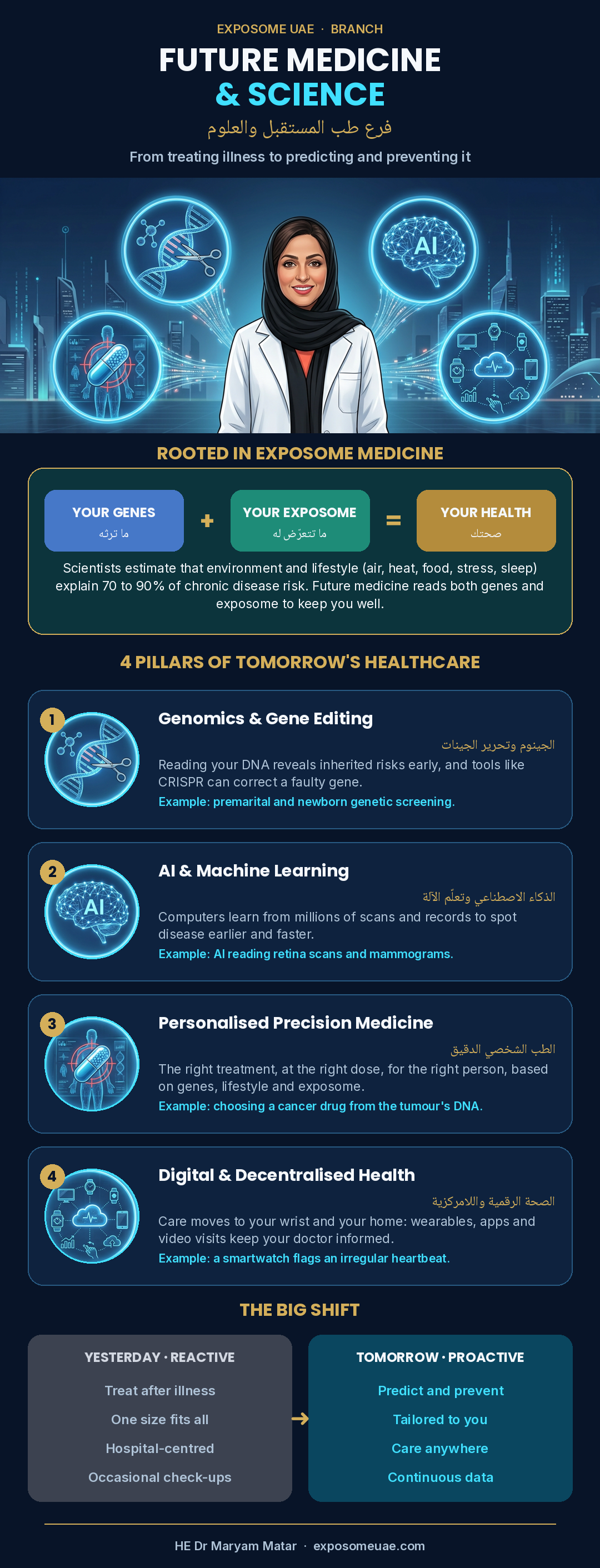
From treatment to prevention
Medicine is changing from treating illness after it appears to predicting and preventing it. This is the focus of our new branch, Future Medicine & Science. [NIEHS, February 2025 (opens in a new tab)]
Rooted in exposome medicine
Your health is your genes plus your exposome: the air you breathe, the heat, your food, stress and sleep. Scientists estimate that environment and lifestyle explain 70 to 90% of chronic disease risk. Future medicine reads both. [Wild 2005 (opens in a new tab)][NHGRI, Epigenomics fact sheet (opens in a new tab)]
Four pillars of tomorrow’s healthcare
- Genomics & gene editing. Reading your DNA reveals inherited risks early, and tools like CRISPR can correct a faulty gene. Example: premarital and newborn genetic screening.
- AI & machine learning. Computers learn from millions of scans and records to spot disease earlier and faster. Example: AI reading retina scans and mammograms.
- Personalised precision medicine. The right treatment, at the right dose, for the right person, based on genes, lifestyle and exposome. Example: choosing a cancer drug from the tumour’s DNA.
- Digital & decentralised health. Care moves to your wrist and your home: wearables, apps and video visits keep your doctor informed. Example: a smartwatch flags an irregular heartbeat.
The big shift
- Yesterday: treat after illness, one size fits all, hospital-centred, occasional check-ups.
- Tomorrow: predict and prevent, tailored to you, care anywhere, continuous data.
The takeaway
Exposome UAE · exposomeuae.com
Informational editorial content, not medical advice. Paragraphs marked Interpretation are the author’s reading of the cited sources.
Sources cited in this essay
- Agency research interviewWoychik R. Epigenetics and the exposome: A new era of disease prevention. NIEHS Environmental Factor, February 2025. Interview with Andrea Baccarelli. Open source (opens in a new tab)
- Peer-reviewed framework commentaryWild CP. Complementing the genome with an “exposome”: the outstanding challenge of environmental exposure measurement in molecular epidemiology. Cancer Epidemiology, Biomarkers & Prevention. 2005;14(8):1847–1850. doi:10.1158/1055-9965.EPI-05-0456. Open source (opens in a new tab)DOISearch PubMed by DOI
- Agency educational fact sheetNational Human Genome Research Institute. Epigenomics Fact Sheet, updated 16 August 2020. Open source (opens in a new tab)
Published 22 October 2026 · Last updated 22 October 2026 · By Dr Maryam Matar
Cite this page
Cite this editorial synthesis, not as primary research. Original studies are listed above.
View citations
Matar, M. (2026, October 22). Future Medicine & Science: From Treating Illness to Preventing It. Exposome UAE. https://exposomeuae.com/essays/future-medicine-and-science
@online{matar2026futuremedicineandscience,
  author = {Matar, Maryam},
  title = {Future Medicine \& Science: From Treating Illness to Preventing It},
  organization = {Exposome UAE},
  date = {2026-10-22},
  year = {2026},
  month = {10},
  url = {https://exposomeuae.com/essays/future-medicine-and-science},
  langid = {english}
}
Related essays
Authored by Dr Maryam Matar